Enterprise Use Cases
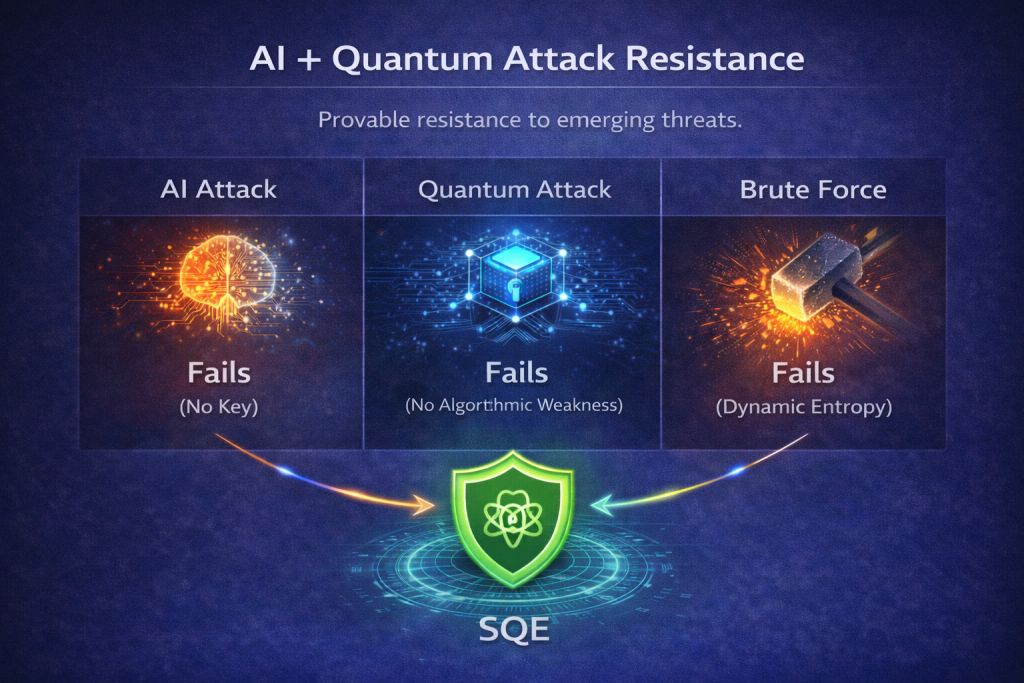
SQE enables mission-critical security across communications, identity, transactions, automation, and digital infrastructure. Powered by Simulated Quantum Entanglement, Proof of Entanglement (POE), and SQid identity architecture, SQE removes the largest vulnerability in modern cybersecurity, key exchange.
Traditional cybersecurity systems attempt to protect encryption keys.
SQE eliminates them entirely.
This architectural shift allows organizations to secure communications, identities, and transactions without the exposure created by key generation, transmission, or storage.
1. Executive & Board-Level Secure Communications
SQE enables organizations to establish quantum-secure communication channels for executives, legal teams, and board members without relying on traditional encryption keys. Because the platform eliminates key exchange entirely, there are no keys to intercept, steal, or store.
This approach provides organizations with a communication environment designed specifically for the most sensitive business conversations, ensuring confidentiality even against future quantum computing threats.

- Board and executive communications
- Mergers and acquisitions negotiations
- Confidential legal discussions
- Government and defense communications
2. Secure Enterprise Messaging
SQE enables secure enterprise messaging where each communication event is independently validated and protected through entangled encryption architecture. Because encryption keys are never transmitted or stored, intercepted data cannot be decrypted even if captured.
This approach allows organizations to communicate sensitive operational information while maintaining strong security and verifiable audit records.
- Secure internal collaboration
- Protected research and development communication
- Regulatory and compliance communications
- Secure collaboration between external partners
3. Quantum-Secure Financial Transactions
Financial systems process enormous volumes of transactions that depend heavily on digital credentials, certificates, and cryptographic keys. These systems are frequently targeted by cybercriminals seeking to exploit authentication weaknesses or intercept financial data.
SQE secures financial transactions by binding each transaction directly to verified digital identity and entangled cryptographic states rather than reusable encryption keys. This eliminates the possibility of replay attacks, credential theft, or key compromise.
By removing the reliance on traditional key exchange infrastructure, SQE enables financial institutions to operate secure payment systems that remain resilient even as quantum computing capabilities emerge.
- Cross-border payments
- Interbank settlement networks
- Digital asset transactions
- Fraud-resistant payment authentication
4. Quantum-Secure Digital Identity (SQid)
Identity is the foundation of modern cybersecurity. Most enterprise identity systems rely on passwords, certificates, tokens, or credentials that can be stolen, reused, or forged.
SQE introduces SQid, a cryptographic identity construct designed to replace traditional credential-based authentication. Each SQid represents a unique digital identity that cannot be duplicated, spoofed, or reused.
By embedding identity directly into the cryptographic architecture, SQE allows organizations to establish authentication systems that no longer depend on vulnerable passwords or certificate-based infrastructure.
- Passwordless enterprise authentication
- Secure workforce access management
- Customer identity verification
- Government digital identity systems
5. Industrial IoT & Machine Authentication
Industrial environments increasingly rely on connected machines, sensors, and automated systems to operate critical infrastructure. These devices often store encryption keys locally, making them vulnerable to compromise if a device is physically accessed or remotely exploited.
SQE enables secure machine-to-machine communication by embedding entangled digital identity directly into devices, eliminating the need for device-level key storage.
This allows organizations to authenticate machines and secure industrial data flows without introducing new key management vulnerabilities across distributed infrastructure.
- Industrial automation systems
- Smart factories and Industry 4.0 environments
- Supply chain verification networks
- Connected infrastructure and smart cities
Secure Data Exchange & File Transfer
Organizations frequently exchange sensitive data such as intellectual property, engineering designs, financial information, and confidential documents with external partners. Traditional encrypted file transfer systems rely on temporary encryption keys or access credentials that may be intercepted or reused.
SQE enables quantum-secure data exchange where files are transmitted through entangled communication sessions tied to verified identities. Because encryption keys are never transmitted or stored, intercepted data cannot be decrypted.
This capability allows enterprises to collaborate securely while maintaining strict control over sensitive information.
- Secure contractor collaboration • Protected intellectual property exchange • Legal and financial document transfer • Secure supply chain data sharing
From Risk Mitigation to Architectural Advantage
It represents a fundamental shift in how digital systems establish trust, authenticate identity, and secure communications.
By removing the key exchange process entirely, SQE eliminates the largest attack surface in modern cryptography and introduces a security model built for the post-quantum digital economy.
Architect the next generation of secure infrastructure with SQE.
Ready to Secure Your Digital Future?
Discover a smarter, quantum-secure approach to cybersecurity.